
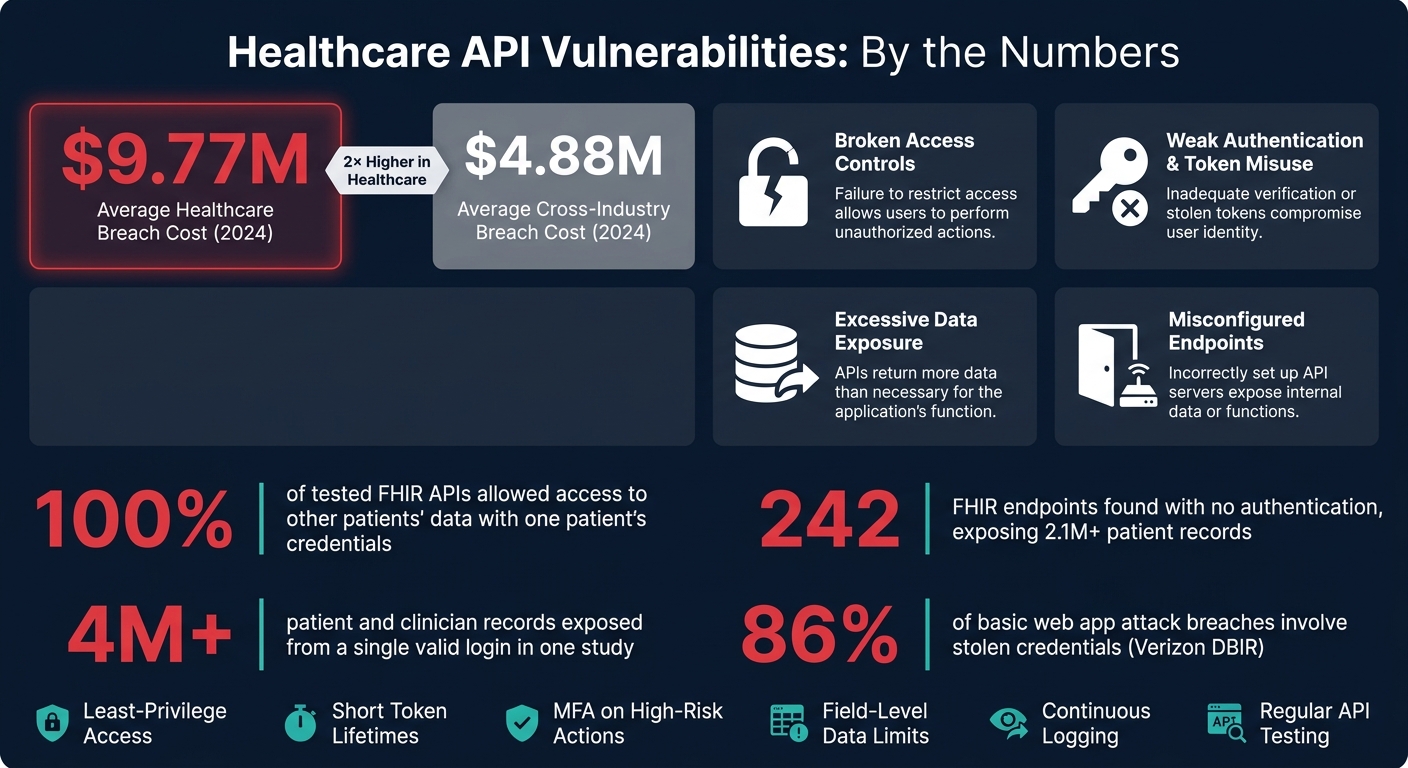
A weak healthcare API can expose PHI fast. In healthcare, the biggest breach paths are broken access checks, weak sign-in controls, overly broad data returns, and open or mis-set endpoints. And the cost is high: healthcare breaches averaged $9.77 million in 2024, versus $4.88 million across industries.
If I had to boil the article down, I’d put it this way:
- APIs are now a direct path to PHI across EHRs, patient apps, portals, labs, and payer systems.
- The API itself usually isn’t the whole problem. The problem is poor access control, weak token handling, and bad exposure settings.
- One stolen login or token can reach far more data than intended when server-side checks fail.
- FHIR and bulk export features can multiply the damage if scopes are too broad or endpoints are exposed.
- Silent exposure is common because bad traffic can look like normal API use.
- The fix is plain: least-privilege access, short token life, MFA for high-risk actions, field-level data limits, logging, and testing of every API that touches PHI.
A few numbers make the risk clear:
- Research cited in the article found 100% of tested FHIR APIs allowed access to other patients’ data with one patient’s credentials.
- One study cited found more than 4 million patient and clinician records exposed from a single valid login.
- An internet scan cited found 242 FHIR endpoints with no authentication, tied to more than 2.1 million patients.
- Verizon DBIR data cited in the article says 86% of basic web app attack breaches involve stolen credentials.
Here’s the core idea: an API bug becomes a reportable healthcare breach when PHI is exposed to the wrong party. Once that happens, HIPAA breach notification rules, OCR review, legal costs, and cleanup can follow.
So when I read this piece, the main takeaway is simple: if you don’t control who can call an API, what data it returns, how long tokens last, and how activity is logged, you’re leaving a direct route into patient data.
Healthcare API Vulnerabilities: Key Breach Statistics & Risk Factors
API Security in Healthcare
sbb-itb-535baee
The API Vulnerabilities Most Likely to Expose PHI
In healthcare, broken authorization, weak authentication, excessive data exposure, and misconfigured endpoints are the API flaws most likely to expose PHI. These are the weak spots that most often turn routine API traffic into a data leak.
Broken Authorization in Patient and Clinical APIs
Broken object-level authorization, or BOLA, happens when an API confirms who the user is but doesn't check whether that user should see the specific record being requested.[5] That gap is dangerous. An attacker can swap a patient ID and pull someone else's chart, lab results, or medication list.[5][8][9][10]
Broken function-level authorization causes a similar issue, but at the action level. If role checks are missing or uneven, a standard account may be able to reach admin functions like bulk exports or permission changes.[5][7][14] In FHIR setups, weak tenant separation and broad scopes can make things even worse. One patient's credentials can end up reaching other patients' records. In one study, that kind of access exposed more than 4 million patient and clinician records.[2][1][18][19]
Weak Authentication, Token Misuse, and Insecure Sessions
Authentication failures are another common route to PHI exposure. Static API keys, weak JWT validation, long-lived OAuth tokens, and hardcoded secrets can let stolen credentials keep working until someone rotates or revokes them.[6][11][12][13]
Long-lived tokens are a major problem in healthcare because they can stay usable for a long time inside a compromised system. HL7 bulk data security guidance addresses this head-on. It recommends OAuth 2.0 access tokens with lifetimes as short as 5 minutes (300 seconds) to limit the blast radius if a token is stolen.[23][24] Missing MFA on bulk exports and admin APIs removes another layer of protection when credentials fall into the wrong hands.
Verizon's DBIR data drives the point home: 86% of basic web application attack breaches involve stolen credentials.[15][16]
Excessive Data Exposure and Misconfigured Endpoints
A lot of healthcare APIs return full records when the client only needs a small slice of data. OWASP now treats excess fields as both a data exposure issue and an authorization issue, since returning more than a user should get is also a failure in access control.[5][20][21][22]
Misconfigured endpoints make that risk much bigger. One internet-scale scan found 242 FHIR endpoints with no authentication, exposing data tied to more than 2.1 million patients.[17] Shadow APIs - undocumented or forgotten endpoints that still answer requests - are especially risky because they often miss current access controls and slip past routine security reviews.
Weak TLS settings and permissive bulk export configurations can also turn a normal interoperability feature into an open data path. That's when a bad setup stops being a technical flaw and becomes a breach: an attacker pairs a valid credential with overexposed data or an open endpoint.
The next risk is how these flaws scale into real breach scenarios.
How API Weaknesses Turn Into Real Breach Scenarios
From a Single Token to Mass Patient Record Access
A stolen credential can open the door to millions of records when server-side authorization breaks down. That’s when an API issue stops being a bug on paper and turns into a breach.
In a FHIR setup, one token can go way beyond what it was meant to access. In Alissa Knight's Playing with FHIR assessment, three FHIR APIs exposed over 4 million patient and clinician records from a single patient login because server-side authorization was not properly enforced.[2][1]
The damage grows fast when object-level authorization is broken and token scopes are too broad. If a token is issued with system/* access instead of patient/*, a stolen session can reach far more data than it should. And features like $export make the problem worse by letting someone pull entire patient populations in one job.[4]
This is what makes API-driven breaches so dangerous: the data doesn’t have to be taken all at once in one loud, obvious dump. With a valid token, an attacker can script requests, sort records by diagnosis, facility, or condition, and pull out large amounts of structured PHI in just a few hours.[3][25]
How Misconfigurations Enable Silent, Long-Duration Exposure
Some API breaches don’t trip alarms. They blend in.
That’s part of the problem. The access may look normal because the attacker is using valid credentials in ways the system still allows. So the traffic doesn’t stand out, even though the outcome is wrong.
If the attacker keeps that access, the exposure can continue quietly for weeks. Long-lived tokens make that much easier. When access tokens stay valid for hours instead of the recommended 15 minutes, a stolen token can keep working long after the first compromise.[4]
Weak monitoring adds another layer of risk. If teams aren’t watching for bulk queries, off-hours data pulls, or unusually broad patient access, the activity can pass as normal API traffic.[26] And when AuditEvent logs are missing or incomplete, it becomes much harder to piece together what happened, which records were touched, and what needs to be reported to regulators and patients.[27]
That is why prevention has to pair strict access limits with continuous monitoring.
Controls That Reduce API Breach Risk in Healthcare
Enforce Strong Authorization, Least Privilege, and Data Minimization
Start by denying PHI access by default. Then allow only approved requests. That one shift shuts down the same kinds of failures that let a valid login or token turn into PHI exposure.[28][34]
Set resource-level rules for each FHIR resource, with role-based read, write, and search permissions.[28][33] Bulk operations such as $export and $everything should be off by default. Turn them on only for vetted service accounts with narrow scopes.[28][33]
Response filtering based on role removes fields a caller doesn't need before data leaves the API. That can include Social Security numbers, detailed behavioral health notes, or sensitive diagnosis codes.[37] It’s the digital version of handing someone a file with half the page blacked out.
Search controls matter too. Pagination and strict _count limits keep a single request from pulling thousands of records at once. If a token is stolen or misused, that cuts down the blast radius fast.[28][37] FHIR Security Labels and Consent resources can also filter sensitive records at runtime, while logging the filtered response for review.[36][37]
Authorization isn't enough on its own. Identity checks and token handling have to be just as tight.
Harden Identity, Encryption, and API Gateway Policies
Use OAuth 2.0 or 2.1 Authorization Code flow with PKCE for mobile apps and single-page apps. Retire implicit flows.[31][33][35] OpenID Connect adds the identity layer, while SMART on FHIR sets a common way to handle scopes, launch context, and patient linking across clinical apps.[31][32]
Access tokens used for PHI should expire in 10–15 minutes. Refresh tokens should be rotated or revoked when something looks off.[30][33][36] For bulk export, keep access tokens to 5-minute lifetimes and skip refresh tokens altogether.[32][38]
Asymmetric JWT signing with RS256 or ES256, plus published JWKS endpoints, lets resource servers verify iss, aud, exp, nbf, and scope locally on every call.[29][36] MFA should protect bulk export, admin configuration, and clinical order signing.[33][35]
Key API Protection Patterns Compared
These controls do their job best when policy is applied the same way across every API layer. The table below shows the main trade-offs.
| Pattern | Implementation Effort | Breach Reduction Value | Operational Overhead | Healthcare Interoperability Fit |
|---|---|---|---|---|
| Centralized gateway enforcement | Medium - requires policy setup | High - consistent policy across all APIs | Low at runtime; higher upfront | Strong - consistent policy across APIs |
| Per-service authorization | High - each service team owns its rules | Variable - depends on team discipline | High - fragmented, harder to audit | Moderate - flexible but risks policy drift |
Coarse-grained scopes (e.g., system/*) |
Low - simple to configure | Low - broad access amplifies breach impact | Low | Poor - broad access |
Fine-grained, patient-specific scopes (e.g., patient/*.read) |
Medium - requires scope design and SMART on FHIR alignment | High - limits exposure to specific patients and operations | Medium - cleaner audit trails | Excellent - aligns with SMART on FHIR, FHIR Bulk Data, and HIPAA minimum-necessary |
| Ad hoc security testing | Low upfront | Low - gaps leave vulnerabilities undetected | Low | Poor - misses new endpoints added during rapid development |
| Secure-by-design API lifecycle | High upfront - security integrated from design through deployment | High - catches issues before production | Medium - embedded in workflow, reduces late-stage rework | Excellent - supports consistent security across EHR integrations, payer APIs, and third-party apps |
Continuous Assessment, Governance, and Conclusion
Inventory, Test, and Monitor Every API That Touches PHI
Once controls are in place, the next job is proving that every live API is known, tested, and watched.
Controls don’t help much if you can’t see what’s out there. Use both top-down and bottom-up discovery. Pull records from EHRs, integration engines, API gateways, and procurement systems. Then scan traffic, cloud configs, and code to spot shadow and zombie APIs. For each API, record its PHI exposure, owner, auth model, and third-party connections.
Testing needs to go beyond basic checks. Penetration tests should cover BOLA, token abuse, and unauthorized bulk export across EHR, lab, scheduling, and claims APIs. It also helps to build automated security scans into CI/CD and run targeted red-team exercises every year, plus after major integration changes.
Logging matters just as much. Centralize logs in append-only storage that sits apart from application data. Log user IDs, patient IDs, request volumes, response sizes, source IPs, and token metadata. Watch for signs like bulk record pulls, off-hours access, and ID enumeration. Those patterns can reveal the same token abuse, bulk pulls, and silent exposure issues discussed earlier. Keep security-relevant logs for six years. Tamper-resistant logs also help OCR determine scope, impact, and notification obligations.
Use Censinet RiskOps™ to Strengthen API Risk Governance
Internal controls only go so far if third-party integrations aren’t governed with the same level of care.
Censinet RiskOps™ helps healthcare organizations standardize third-party API risk assessments, benchmark vendor controls, and track remediation for PHI-bearing integrations.
Conclusion: Why API Flaws Lead to Breaches
Taken together, these controls cut both the odds of exposure and the size of the blast radius.
Healthcare APIs play a central role in interoperability, patient apps, remote monitoring, and cross-organization exchange. But every API that touches PHI is also a direct, programmatic route into highly sensitive data. Broken authorization, weak token handling, misconfigured endpoints, and unmonitored export paths have each turned routine access into large-scale PHI exposure.
The fix isn’t mysterious. Use least-privilege authorization, strong identity and token policies, data minimization, encrypted transport, and rate limiting. The problem is usually consistency. Teams may apply these controls well in one system, then leave gaps in another internal tool or a connected vendor integration. Lowering API breach risk takes continuous discovery, testing, remediation, governance, logging, and incident response.
FAQs
What is BOLA in a healthcare API?
Broken Object Level Authorization (BOLA) is an API security risk that shows up when an API fails to check whether someone should have access to a specific data object.
In healthcare, that can open the door to sensitive patient records or other private health information. An attacker may simply change an identifier in an API request, like a patient ID, and get data they should never see. The problem is straightforward: the API returns the data without making sure the caller has permission to access that exact resource.
Why are FHIR APIs a high breach risk?
FHIR APIs carry a high breach risk because they often include security gaps like broken object-level authorization, overly broad token scopes, weak input validation, and weak transport security. Put simply, one weak link can open the door to unauthorized access and large-scale exposure of PHI.
They also tend to sit at major connection points between internal systems, third-party vendors, and cloud-hosted services. That setup expands the attack surface and can lead to undocumented data transfers if governance and oversight are weak.
How can hospitals reduce API breach risk?
Hospitals can cut API breach risk by keeping a current API inventory, mapping how PHI moves through each endpoint, and limiting access to the minimum necessary. That means using OAuth 2.0/SMART on FHIR and short-lived tokens so access stays tight and expires fast.
An API gateway should sit in front of these connections to handle the basics that can't be skipped:
- Authentication and authorization
- Schema validation
- Rate limits
- Audit logging
It also helps to review vendor APIs before go-live instead of treating third-party connections as safe by default. On top of that, teams should watch for unusual activity, retire old API versions, encrypt data in transit with TLS 1.2+, and store keys in KMS/HSM rather than leaving them exposed.
