
If a networked medical device fails during a cyberattack, patient care can fail with it. I’d sum this up in one line: NIST CSF gives hospitals a clear way to manage device cyber risk from purchase to retirement.
Here’s the short version:
- Medical device security is now tied to patient safety, not just IT.
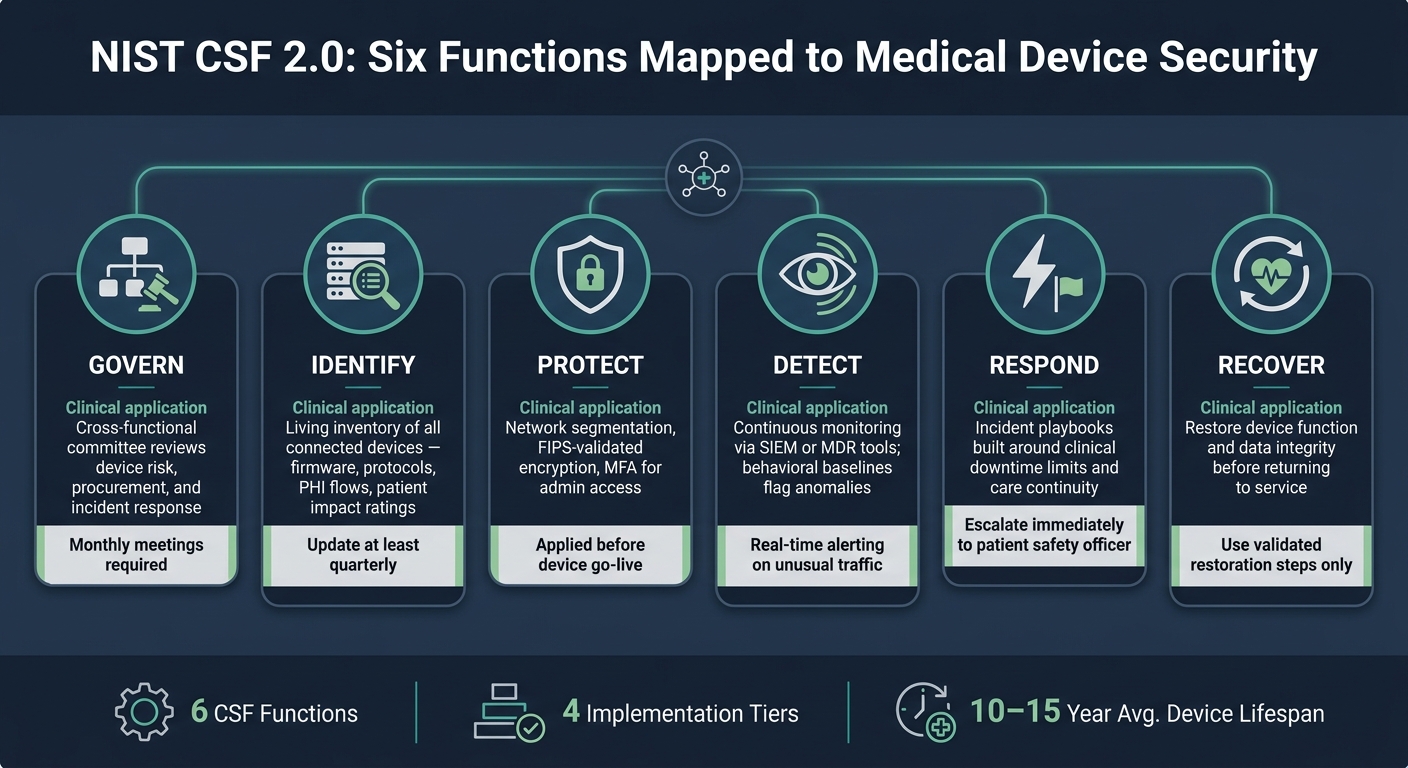
- NIST CSF 2.0 gives teams six functions to work from: Govern, Identify, Protect, Detect, Respond, and Recover.
- FDA QMSR took effect on February 2, 2026, which ties cybersecurity more closely to device quality work.
- Many medical devices stay in use for 10 to 15 years, so older systems often need network isolation, exception tracking, and other backup controls.
- A solid program starts with inventory, risk ranking, ownership, patch planning, monitoring, and end-of-life cleanup.
- The work has to be shared across clinical engineering, IT security, procurement, compliance, risk, and clinical leadership.
If I were reducing the article to the parts that matter most, I’d put it this way:
-
Know what devices you have.
Track model, firmware, protocols, data flows, and patient impact. -
Set ownership early.
If no one owns patching, reviews, or incident steps, work stalls. -
Use the CSF across the full lifecycle.
Apply it in design, buying, onboarding, daily use, legacy support, and retirement. -
Plan for care continuity.
A device cyber event can become a patient safety event fast. -
Keep records that stand up to review.
That includes risk exceptions, SBOMs, vendor evidence, and remediation status.
A few facts stand out:
- 6 CSF functions now shape the framework
- 4 implementation tiers help teams rate risk management maturity
- 10–15 years is a common medical device service life
- Quarterly inventory updates are a good baseline from the article
- Monthly committee meetings help keep work moving across teams
I also see the article making one practical point: CSF is useful because it gives different hospital teams one shared structure. Clinical engineering, IT, compliance, and patient safety can all work from the same map instead of running separate programs.
| Area | What the article says to do |
|---|---|
| Governance | Use a cross-functional committee and clear escalation paths |
| Asset management | Keep a living inventory and classify devices by patient impact |
| Protection | Segment networks, use encryption, and limit admin access |
| Monitoring | Watch device behavior and flag unusual traffic |
| Response | Build playbooks around downtime limits and care needs |
| Recovery | Restore device function and data safely before reuse |
| Procurement | Ask vendors for SBOMs, patch timelines, and disclosure policies |
| Legacy devices | Isolate them and document risk exceptions |
| Retirement | Wipe PHI, dispose of data safely, and remove devices from inventory |
So if you want the plain-English takeaway, it’s this: the article argues that NIST CSF helps hospitals turn medical device cybersecurity into a repeatable program with ownership, records, and patient care kept front and center.
NIST CSF core concepts applied to medical devices
Core, Profiles, and Tiers in a medical device program
NIST CSF has three parts: the Core, Profiles, and Implementation Tiers. Each one has a clear job in a medical device security program.
The Core groups cybersecurity outcomes into six functions: Govern, Identify, Protect, Detect, Respond, and Recover. Those functions apply across the full device lifecycle. Just as important, the Core describes the outcomes you want. It does not tell you the exact steps to take.
Profiles connect the framework to business needs and risk tolerance. A Current Profile shows where the security program stands today. A Target Profile shows where it needs to go. The gap between the two becomes the remediation roadmap.
Implementation Tiers use a scale from 1 to 4 to help teams build risk management over time with real-time benchmarking. Tiers describe maturity, not performance.
In a medical device program, these three parts help turn broad guidance into a shared way of working.
How the six CSF functions map to clinical environments
The six functions start to make sense fast when you tie them to day-to-day clinical work.
| CSF Function | Clinical Application |
|---|---|
| Govern | A cross-functional committee reviews device risk, procurement, and incident response[1] |
| Identify | An authoritative inventory of all connected devices, documenting firmware versions, communication protocols, clinical impact ratings, and PHI flows[1][2] |
| Protect | Network segmentation isolates devices from general IT traffic, validated encryption secures data in transit and at rest, and MFA controls administrative access[1] |
| Detect | Continuous monitoring with SIEM or MDR tools establishes behavioral baselines and flags anomalies - such as an infusion pump contacting an external IP address[1] |
| Respond | Incident playbooks built for clinical downtime and no-reboot constraints keep response focused on care continuity[1][2] |
| Recover | Device functionality and data integrity are restored while maintaining care continuity[1] |
This structure becomes even more useful in long-lived clinical environments. Medical devices often stay in service for 10 to 15 years, which means older systems can limit your control options. In those cases, teams may need compensating controls like dedicated VLANs or air-gapping[1][2].
How CSF aligns with U.S. healthcare and device guidance
CSF makes the most sense when used alongside the standards and rules shaping U.S. healthcare devices right now. For medical devices, it lines up well with current U.S. regulatory expectations.
NIST SP 800-213, finalized in early 2025, is the main framework for medical device cybersecurity. It addresses limits tied to clinical settings, including FDA validation requirements for patching[1].
The FDA's Quality Management System Regulation (QMSR) took effect on February 2, 2026. It incorporates ISO 13485:2016 and makes cybersecurity part of device quality and safety[1][3].
On the postmarket side, CSF supports coordinated vulnerability disclosure, patch management, and Software Bill of Materials (SBOM) practices that the FDA is asking for more often from manufacturers[2][3]. Procurement teams can also use CSF alignment when comparing new devices. For example, they can ask for proof of a manufacturer's vulnerability disclosure process and patch timelines before buying[1].
CMS has also expanded its audit scope to include real-time cybersecurity compliance verification during Medicare surveys[1]. That makes a documented, CSF-aligned program a practical common language for healthcare delivery organizations managing device risk across the full lifecycle.
sbb-itb-535baee
Connecting and Securing Medical Devices: Designing for Compliance and Resilience
Building a NIST CSF program for medical devices
NIST CSF 2.0: Six Functions Mapped to Medical Device Security
Start with inventory, classification, and risk assessment
Once the CSF target profile is set, turn it into a device-by-device operating list.
Start with a living inventory of every connected device. For each one, track the model, firmware, connectivity, protocols, encryption, and authentication. Then rank devices by patient impact if they fail or get compromised. Infusion pumps, ventilators, and patient monitors belong at the top of that list [1].
Next, add vulnerability data from FDA Medical Device Reporting databases, manufacturer security bulletins, and NIST's Medical Device Cybersecurity Database. That gives you a risk view tied to critical medical device security risks and active threat intelligence, not guesswork [1]. Update this at least quarterly, and keep it synced between biomedical engineering and IT security [1]. If internal scans miss details, use manufacturer SBOMs to close those gaps.
Define governance, ownership, and lifecycle responsibilities
Clear ownership keeps the program moving. Without it, patching gets delayed, procurement skips security review, and incident response drags.
A cross-functional medical device cybersecurity committee should meet at least once a month, with representation from clinical operations, biomedical engineering, IT security, compliance, and risk management [1]. Here’s how the work breaks down:
| Role | Primary Responsibility | Lifecycle Focus |
|---|---|---|
| CISO / IT Security | Network segmentation, MFA, continuous monitoring, and SIEM integration | Operations, Respond |
| Biomed / Clinical Engineering | Asset inventory, firmware patching, and device-specific configuration | Onboarding, Maintenance |
| Procurement | Evaluating manufacturer security maturity and SBOM acquisition | Selection, Procurement |
| Compliance Officer | CMS/FDA reporting and maintaining the risk-based exception log | Governance, Recover |
| Clinical Leadership / Patient Safety Officer | Patient safety impact analysis and downtime coordination | Respond, Recover |
| Vendors / Manufacturers | Vulnerability disclosure and providing validated update procedures | Design, Post-Market |
One rule is worth setting early: any cybersecurity event involving a medical device should be escalated to the patient safety officer and clinical leadership right away [1].
Implement controls across the core CSF functions
With ownership in place, put controls in place based on device criticality. For high-priority devices, use segmentation, validated encryption, and MFA [1].
Use continuous monitoring to build a behavioral baseline for each device. That way, unusual activity triggers an alert instead of slipping by unnoticed [1].
Patch management in clinical settings needs tight coordination. Match deployment schedules to clinical downtime windows. If a patch can't be applied because of FDA validation constraints, document the risk in a formal way and put a compensating control in place [1]. Incident response playbooks should tie into patient safety workflows, and teams should use validated restoration steps before devices go back into service [1].
Applying NIST CSF across the medical device lifecycle
Use CSF in secure design, procurement, and onboarding
Use the CSF to turn program controls into lifecycle checkpoints.
The CSF fits every stage of a device’s life, from design to retirement. In design and validation, that means using threat modeling, SBOMs, and penetration tests. On the buying side, turn CSF categories into plain contract terms using automated vendor risk solutions. Update RFPs to clearly require NIST SP 800-213 compliance, FDA QMSR adherence, effective February 2, 2026, documented patch management timelines, and proof of a vulnerability disclosure policy. That link between buying rules and day-to-day risk helps keep purchasing tied to patient safety, not just legal wording[1].
During onboarding, put technical safeguards in place before first use. Place each device in a VLAN or DMZ before go-live. Require FIPS-validated cryptography and MFA for admin access and firmware functions. Before go-live, compare the SBOM against known CVEs[1][4].
Manage operations, legacy devices, and decommissioning
In daily operations, move from periodic scans to continuous, automated monitoring. Use behavioral baselines to spot unusual device traffic in real time. Update inventory every quarter with firmware versions, protocols, and clinical impact ratings[1].
Legacy devices need compensating controls. That can include isolation, air-gapping where feasible, and hardware access restrictions. Document each exception with a formal risk assessment and review it every year[1][2].
Retirement deserves as much care as deployment because security gaps often show up at shutdown. At end of life, sanitize PHI, securely dispose of data, and remove the device from inventory[1][2].
These lifecycle checkpoints create the evidence needed for risk reviews and governance.
Operationalizing medical device risk management with Censinet
The previous section laid out the controls. This section shows what it looks like to turn those controls into repeatable day-to-day work across devices, vendors, and clinical teams.
The aim isn't more paperwork. It's faster ownership, cleaner evidence, and faster remediation.
How Censinet RiskOps supports CSF-aligned medical device security
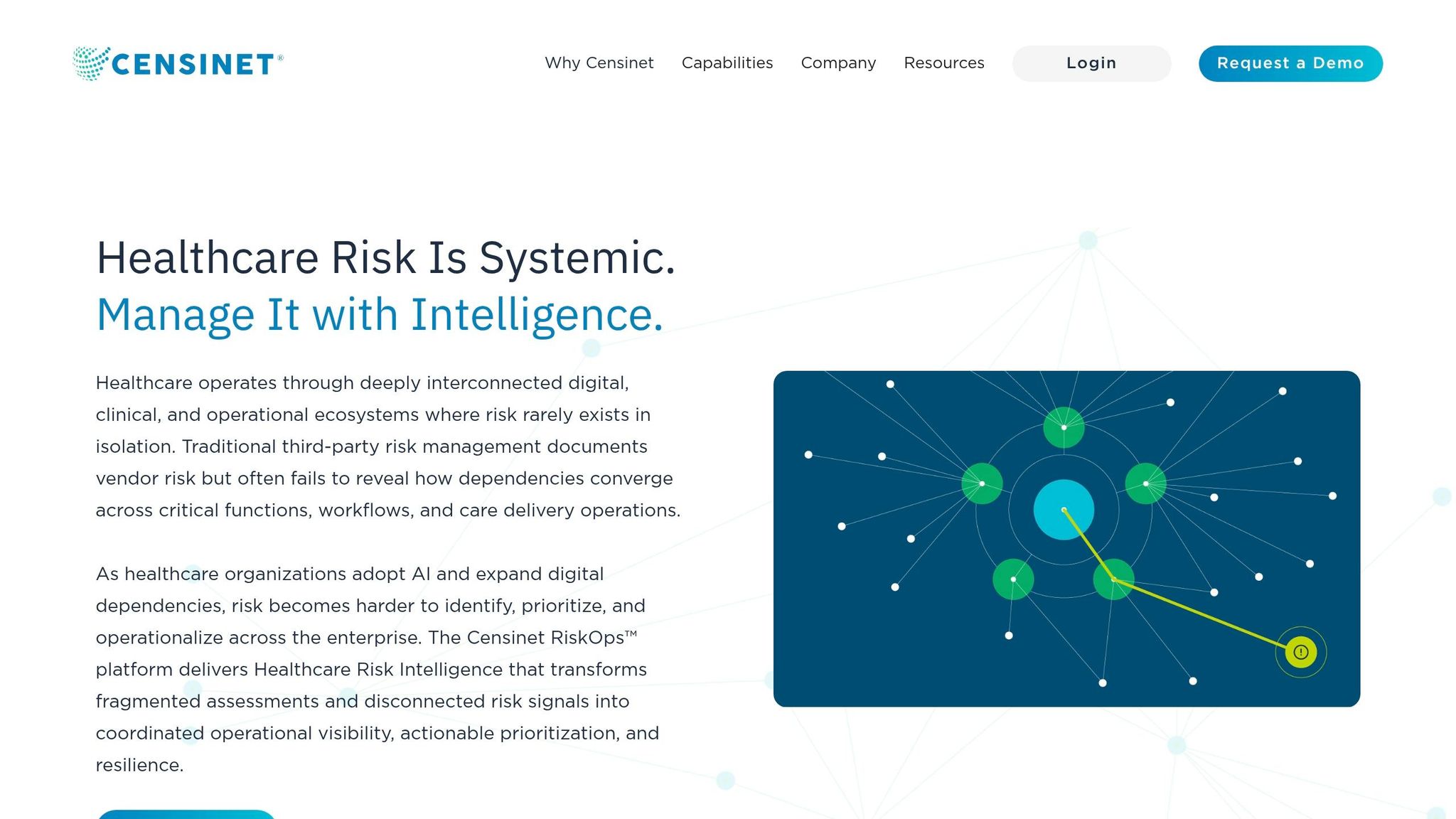
Censinet RiskOps™ is built for healthcare. It helps HDOs manage CSF-aligned assessments across medical devices, suppliers, and clinical workflows. Instead of tracking status in scattered emails and spreadsheets, teams can see assessment status, remediation progress, and governance evidence in one place.
Security and clinical engineering teams can use it to run vendor questionnaires, collect manufacturer evidence such as SBOMs and vulnerability disclosure policies, and send findings to the right stakeholders. Closed-loop routing pushes findings to procurement, clinical engineering, security, and risk management while keeping accountability clear.[1]
How Censinet AI and Censinet AITM help scale assessments and governance
At scale, the main bottleneck usually isn't finding risk. It's reviewing the evidence fast enough to do something about it.
Censinet AI™ automates evidence validation, policy drafting, and mitigation planning, while still keeping human review in the loop and sending findings to the right teams.
Censinet AITM helps move the vendor side along faster. It helps vendors complete security questionnaires, automatically summarizes evidence and documentation, captures fourth-party risk exposures, and drafts risk summaries. That matters because fourth-party dependencies can affect multiple devices and shared services.
The table below maps key Censinet capabilities to the CSF functions they support most directly:
| CSF Function | Censinet Capability |
|---|---|
| Identify | Centralized device inventory, third-party risk assessments, and supply chain risk visibility |
| Protect | Vendor questionnaires, SBOM evidence collection, and vulnerability disclosure policy review |
| Detect | Alerts on new third-party exposures and fourth-party risks |
| Respond | Automated routing of findings to biomed, security, and procurement stakeholders; closed-loop remediation tracking |
| Recover | Documented mitigation plans and post-incident governance tracking |
Taken together, Censinet RiskOps, Censinet AI, and Censinet AITM give HDOs a practical way to put CSF alignment into daily work at scale, with ownership assigned, evidence documented, and remediation kept in motion.
Conclusion: A practical path to stronger device security with NIST CSF
Medical device cybersecurity is now a compliance requirement, not a side job for IT. That shift matters because device security works best when governance, clinical operations, and IT use the same playbook.
NIST CSF gives teams that structure, providing a framework for standardized assessments. Many devices remain in service for 10 to 15 years, and in many cases they outlast support for their operating systems.[2] A shared framework helps clinical engineering, IT security, risk management, and clinical leadership work from the same set of priorities. Day to day, that means treating device risk as a patient safety issue at every point in the lifecycle.
If ransomware knocks out an infusion pump or ventilator, that’s not just a network problem. It’s a patient safety incident.[1] Used across the full device lifecycle, CSF keeps that fact front and center.
The path ahead is pretty clear: inventory devices, close gaps, segment networks, tighten procurement, and assign ownership. None of this depends on one team doing everything at once. It depends on steady progress, clear governance, and close coordination across internal teams and vendors.
FAQs
How do we start using NIST CSF for medical devices?
Start with a full risk assessment that catalogs your medical devices, including firmware versions, connectivity status, and communication protocols. From there, map each asset and its risks to the NIST CSF core functions: Identify, Protect, Detect, Respond, Recover, and Govern.
Censinet RiskOps™ can make this work a lot easier. It helps teams track risk, compare results against peers, and review third-party risk, so healthcare organizations can stay on top of device vulnerabilities while supporting patient safety and day-to-day clinical operations.
What should we do if a legacy device cannot be patched?
If a legacy medical device can't be patched, use compensating controls to lower risk. Start with network segmentation so the device is separated from critical systems. That way, if something goes wrong, the blast radius stays smaller.
You can also add other safeguards, such as:
- virtual patching through firewall rules or intrusion prevention systems
- device hardening
- least-privilege access
- continuous monitoring with AI-based anomaly detection
Just as important, make sure the device is part of your incident response plans. And while short-term controls matter, so does the bigger picture: put long-term replacement planning near the top of the list. Censinet RiskOps™ can help identify, assess, and manage these vulnerabilities across the enterprise.
How does NIST CSF support patient safety during a cyber incident?
The NIST Cybersecurity Framework (CSF) helps support patient safety by giving healthcare organizations a clear, repeatable way to manage cyber risks that could disrupt clinical operations.
When an incident hits, the framework’s Respond and Recover functions guide teams on how to contain threats, limit damage, and get device functionality back online. Current device inventories and contingency plans make fast action a lot easier, which helps keep patient care from being interrupted.
